Trending
Crime is a complicated and persistent social problem that impacts communities all around the world, creating fear, injury, and long-term social consequences. For ages, scientists in subjects such as criminology, sociology, and psychology have attempted to explain why some people engage in criminal behaviour and others do not, even when faced with similar conditions. This question is still crucial to discussions about justice and public safety.
The aim of this article is to investigate the underlying causes of crime by looking at major elements such as socioeconomic status, psychological impacts, environmental settings, and substance usage. By understanding how these elements interact and impact behaviour, the article hopes to raise awareness and support more effective, preventive methods to creating a safer society.
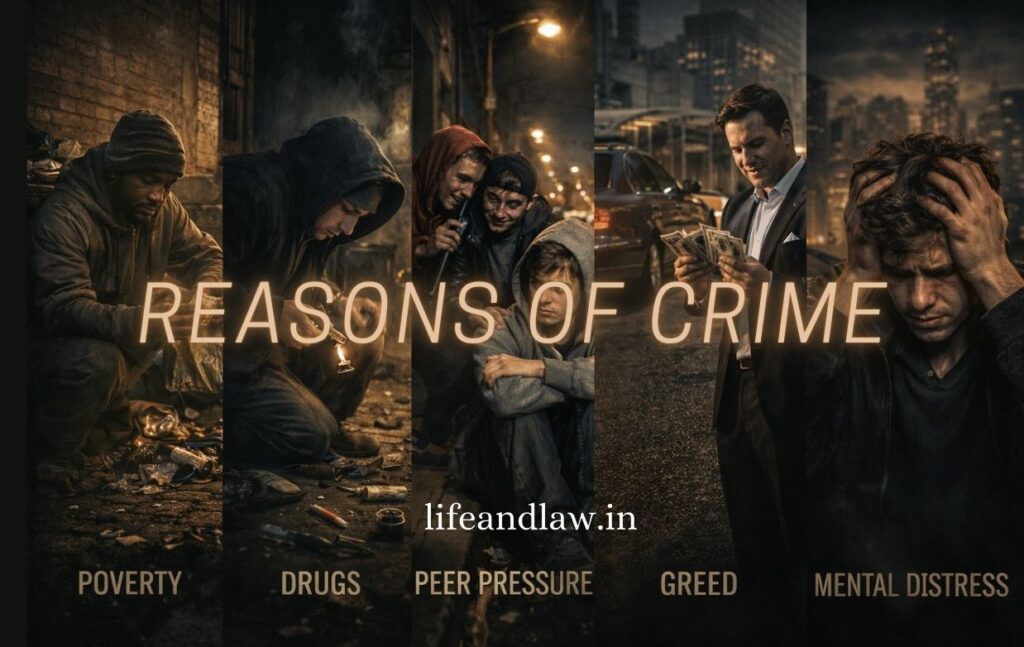
One of the most frequently mentioned causes of crime is socioeconomic position. Poverty, wealth disparity, and a lack of opportunities all have a substantial impact on criminal behaviour. Studies have found a strong correlation between poverty and crime rates, with economically disadvantaged communities frequently suffering higher rates of both violent and property crime. People living in poverty situations may turn to crime as a way of survival or to advance their standing in a society that associates riches with achievement.
Education and employment prospects are also important, according to research. A lack of access to high-quality education and job training can contribute to criminal behaviour, particularly among young people. When faced with few opportunities for advancement, some individuals turn to criminal activities such as stealing, drug trafficking, or even organised crime. For example, the United Nations Office on Drugs and Crime (UNODC) observes that nations with higher levels of unemployment have higher rates of crime, as people seek other means to meet fundamental requirements.
In addition to poverty and education, income disparity has a significant impact. Areas with wide disparities between affluent and poor tend to have higher crime rates, particularly violent crime. People who feel excluded and frustrated on the lower end of the economic spectrum may commit crimes in order to level the playing field.
Beyond environmental influences, psychological considerations play an important part in criminal behaviour. Mental health issues, trauma, and emotional anguish are all linked to crime. Untreated disorders such as antisocial personality disorder, schizophrenia, or bipolar disorder can lead to violent or antisocial behaviour. Many people avoid seeking care because of the stigma associated with mental health, and untreated disorders can lead to criminal activity.
Another important psychological issue is the effect of childhood trauma. According to studies, people who have experienced abuse, neglect, or domestic violence in their childhood are more likely to participate in criminal behaviour later in life. Childhood trauma, according to the National Institute of Justice, can impair emotional development and lead to maladaptive behaviours, including criminal activity. Many criminal offenders have histories of abuse, neglect, or abandonment, implying that early intervention and trauma-informed care could play an important role in lowering crime rates.
Peer pressure and substance misuse both contribute to criminal activity. Peer influence is especially powerful among young individuals. According to research, when people’s social groups normalise or support criminal behaviour, they are more likely to engage in illegal activity. When combined with the impacts of addiction, this might result in a dangerous cycle. Substance addiction, whether it involves alcohol, drugs, or other substances, affects judgement and can lead to criminal behaviour that would otherwise be avoided.
The setting in which a person grows up can have a significant impact on their risk of committing crime. Individuals from dysfunctional families, who lack emotional support, guidance, and positive role models, are more likely to engage in criminal behaviour. A lack of strong familial relationships and supervision might expose youngsters to undesirable influences.
Similarly, living in high-crime areas may normalise criminal behaviour. In locations where law enforcement is scarce and crime is common, people may believe that engaging in criminal activities is not only acceptable, but also necessary for life. According to social disorganisation theory, societies without social cohesion, such as those with high poverty rates and low levels of collective efficacy, are more likely to engage in criminal behaviour. When crime is perceived as a regular part of daily life, people, particularly young people, are more likely to engage in it.
Cultural factors are also important. In some subcultures, crime may be glorified or even seen as a respectable way to attain prestige or power. Media depictions of crime, particularly in films and music, can make criminal behaviour appear thrilling or heroic. For example, in some areas, gangs may be romanticised, prompting young people to join in search of a feeling of belonging and identity, even if it means engaging in illegal activity.
Substance misuse is one of the most significant contributors to criminal behaviour, with a clear and direct link to a wide range of crimes. According to the National Institute on Drug Abuse, drug addiction can lead to a variety of criminal behaviours, including property crimes (such as theft) and violent offences (such as assault or robbery). Desperation to support an addiction frequently motivates people to conduct crimes they would not otherwise consider.
Cocaine, heroin, and methamphetamine are particularly linked to criminality. When people become dependent on these substances, their capacity to make rational judgements suffers, and they may engage in unlawful activities to maintain their addiction. Furthermore, the drug trade is a criminal activity, with violence frequently accompanying the distribution and sale of illicit narcotics.
The cycle of addiction and crime is self-sustaining. Once a person is caught up in this cycle, they are more likely to reoffend. Jail or jail terms may temporarily deter criminal behaviour, but without effective rehabilitation and addiction treatment, recidivism is high. Rehabilitation programs that target both substance abuse and criminal behaviour are critical for breaking the cycle.
Crime is the result of a complicated combination of social hardship, psychological obstacles, environmental pressures, and substance misuse. Poverty, a lack of education, mental health concerns, trauma, peer influence, and addiction are all common factors that can lead to criminal behaviour. Addressing these underlying issues through education, healthcare, social assistance, and rehabilitation is critical for creating safer and more equitable communities.
This viewpoint is consistent with that of Adv. Abdul Mulla, who frequently discusses legal and social issues on venues such as www.asmlegalservices.in and www.lifeandlaw.in, emphasising prevention, understanding, and structural reform above punitive tactics.
Adv. Abdul Mulla (Mob. No. 937 007 2022) is a seasoned legal professional with over 18 years of experience in advocacy, specializing in diverse areas of law, including Real Estate and Property Law, Matrimonial and Divorce Matters, Litigation and Dispute Resolution, and Will and Succession Planning. read more….
Copyright BlazeThemes. 2025