Loading ...

Life & Law

RECENT NEWS

From Thought to Trial: Understanding the Stages of a Crime

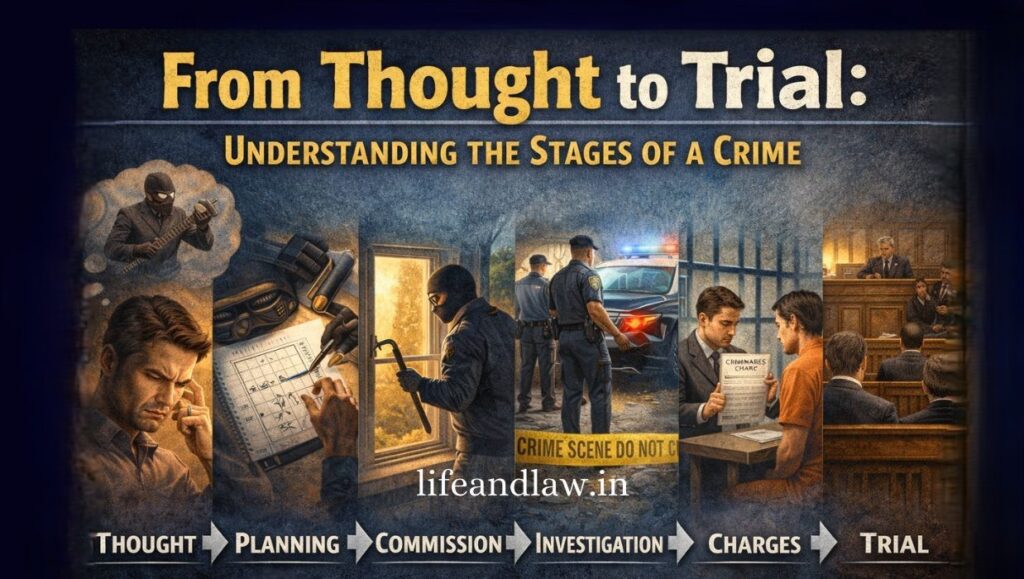
Crime is not a single occurrence, but rather a complex process that occurs in stages, beginning with a person’s initial thinking and ending with the final trial. Each stage is critical to the legal system, guaranteeing a thorough investigation and fair processes before a verdict is reached.

This article seeks to investigate and explain these stages, offering light on the complexities of criminal behaviour, law enforcement, and the court system, grasping these processes allows readers to have a better understanding of how the judicial system operates to ensure fairness and accountability.

Stage 1: The Initial Thought

The criminal process often starts long before a crime is committed. In truth, many crimes begin with momentary thoughts, emotional responses, or strongly held wishes. At this point, a person may consider committing a crime for a variety of motives, including financial gain, retribution, or an emotional outburst. These thoughts are frequently impacted by psychological, social, or environmental variables. For example, someone in acute financial difficulties may consider thievery, but someone in an abusive relationship may consider violent retaliation.

Motivation is crucial at this time. Some crimes are impulsive—acts of passion or abrupt provocation—while others are deliberate, requiring extensive organisation and consideration. Premeditation is especially essential in legal contexts since it might be the deciding factor in distinguishing between different sorts of crimes. A first-degree murder charge, for example, often requires evidence of premeditation, whereas a second-degree murder or manslaughter charge usually involves crimes of passion or a lack of prior planning.

Psychological issues are equally important here. Personality disorders and significant emotional anguish can alter a person’s perception of reality and make them more likely to act on hazardous impulses. Similarly, social factors such as poverty or peer pressure might act as additional motivators for crime.

Stage 2: The Commission of the Crime

When thinking becomes action, the crime is committed. This is the most apparent and palpable stage of the criminal justice process. The concept of actus reus (the bodily act of committing a crime) is crucial here. It is not enough for someone to simply consider committing a crime; they must actively carry it out in some way. Whether it’s a robbery, assault, fraud, or vandalism, the act itself might vary widely in terms of execution and severity.

Depending on the conditions, criminal behaviour may still be spontaneous. For example, someone may commit a crime in the heat of the moment, driven by emotions like rage, fear, or vengeance. Alternatively, other people methodically prepare their actions over time, ensuring that every detail is handled flawlessly. Crimes like fraud, organised crime, and certain types of homicide are frequently the result of meticulous planning and execution.

Crimes are also characterised by severity, which has important legal ramifications. Felonies are regarded as significant crimes and entail heavier penalties, such as imprisonment for more than a year or the death penalty. Misdemeanours, on the other hand, are less serious offences that typically result in smaller consequences, such as fines or brief jail sentences. Understanding the nature of the crime is critical for law enforcement since it determines the resources needed for investigation and prosecution.

Stage 3: Discovery and Investigation

After the crime has been committed, the next critical stage is its discovery. This could happen in a variety of ways, including a witness reporting the crime, the victim coming forward, or law police detecting it through surveillance or forensic evidence. The discovery process begins when authorities are contacted and an investigation into the crime is launched.

Investigations are methodical, with law enforcement personnel gathering evidence, interviewing witnesses, and reviewing accessible surveillance footage. In today’s world, technology plays an important role in criminal investigations. Forensic science, which includes DNA analysis, fingerprint identification, and digital forensics, has transformed the investigative process, allowing police to hunt down criminals more efficiently than ever before.

Once the evidence has been gathered, investigators begin to develop a narrative of what happened, frequently reconstructing the events that led up to the crime. The ultimate aim of the inquiry is to acquire enough evidence to warrant an arrest while also ensuring the integrity of the judicial process. Importantly, due process must be followed to ensure that the evidence is collected legitimately and avoid future legal problems in court.

Stage 4: Arrest and Charging

When enough evidence is acquired, authorities may decide to initiate an arrest. The arrest is usually made based on probable cause, which implies that the police feel there is sufficient evidence to imply that the suspect committed the crime. Arrests follow established legal procedures, and suspects are frequently informed of their rights, which advise them of their right to remain quiet and to an attorney.

After arresting the defendant, the prosecutor determines whether or not to prosecute them formally. This conclusion is based on the quality of the evidence gathered. If the evidence is substantial, criminal charges are filed, and the person is formally charged in court. At this point, a suspect may be scheduled for a preliminary hearing or arraignment, during which they will be officially informed of the charges against them.

Stage 5: The Trial

The trial is the ultimate stage in the criminal procedure, during which the defendant’s guilt or innocence is determined. However, not all cases reach this point; many are handled prior to trial through plea bargaining, in which the defendant pleads guilty in exchange for a lower sentence.

If the matter goes to trial, the defence and prosecution will each provide opening statements. Both sides then present evidence, call witnesses, and argue their case. The burden of proof is with the prosecution, who must prove the defendant’s guilt beyond a reasonable doubt. The defense’s role is to raise doubts about the prosecution’s case, whether by cross-examination, giving an alibi, or presenting evidence of the defendant’s innocence.

During the trial, the judge serves as a neutral arbiter, ensuring that both parties follow legal norms and procedures. If a jury is present, they will deliberate and make a decision. The possible verdicts are guilty, not guilty, or hung jury (when the jury cannot reach a unanimous conclusion). If the offender is found guilty, the court will proceed with sentencing, determining the appropriate punishment based on the gravity of the crime and other considerations.

Conclusion

Understanding the stages of a crime, from purpose to trial, demonstrates how each element contributes to a fair and just criminal justice system. Psychological elements, investigation, and judicial scrutiny all contribute to the meticulous examination of the facts and the legal determination of outcomes.

Finally, the system attempts to punish the guilty while protecting the innocent through due process and legal safeguards. Adv. Abdul Mulla, who writes on law and justice through his legal platforms www.asmlegalservices and www.lifeandlaw.in, shares this perspective, with a focus on legal awareness and rights.

RECENT POSTS

CATEGORIES

Leave a Reply

Your email address will not be published. Required fields are marked *

Life And Law Blogs

Life & law provides valuable insights by simplifying complex legal concepts and connecting them to real-life experiences …read more

Why I write

At Life & law, my mission is simple. to make the law accessible and empower people with knowledge to confidently face life’s challenges …read more

Copyright BlazeThemes. 2025