Trending
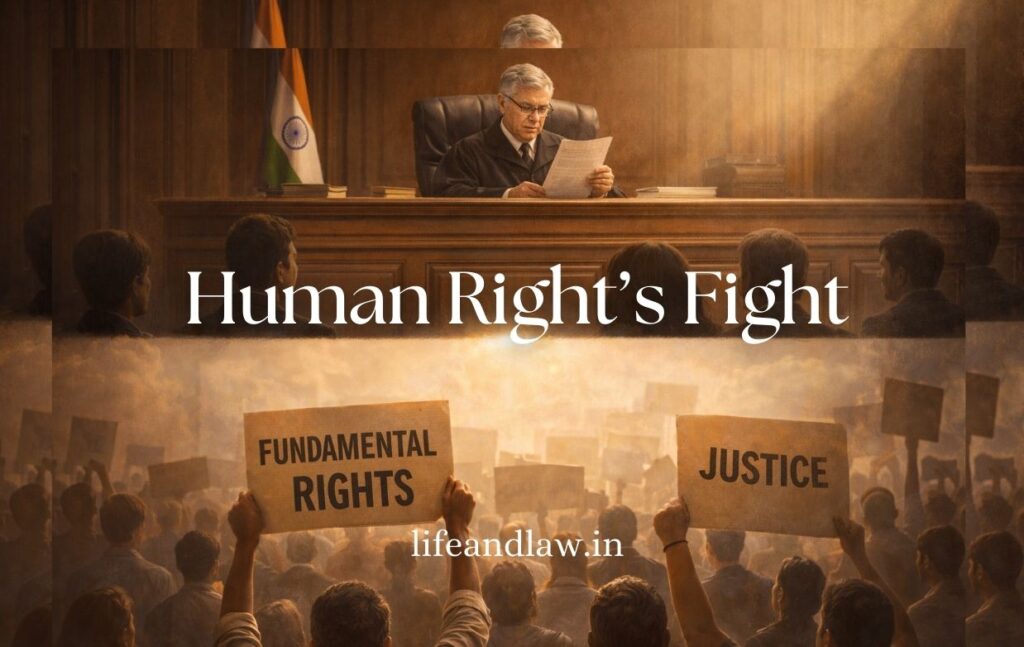
Human rights are the foundation of a just and equitable society, yet their protection has never been guaranteed. Ordinary people, marginalised communities, and devoted activists all across the world have battled long-standing prejudice and oppression, frequently resorting to the judiciary for justice. Legal fights in courts have frequently established transformative precedents, altering societies and strengthening the rule of law.
This article tries to highlight key examples from both the global and Indian settings, demonstrating how perseverance, courage, and legal advocacy have benefited human rights. It emphasises that justice is actively fought and defended, rather than passively granted.
Some of the most significant human rights victories have come from courts all across the world, altering laws and society. A prominent example is Brown v. Board of Education (1954, USA), in which the United States Supreme Court overturned racial segregation in public schools. The Supreme Court famously proclaimed that “separate but equal is inherently unequal,” a theory that ended decades of legalised discrimination and became a pillar of the civil rights movement.
Following the atrocities of World War II, another significant event occurred: the Nuremberg Trials (1945-46). For the first time, an international tribunal prosecuted political and military leaders for crimes against humanity, genocide, and war crimes. These trials created a global precedent: persons cannot commit human rights violations while hiding in positions of power. Similarly, instances such as Roe v. Wade (1973) in the United States emphasised the judiciary’s responsibility in defending personal liberties, including reproductive rights, demonstrating the range of human rights law.
These global judicial conflicts highlight a common thread: persistence in the face of systemic injustice, as well as courts’ commitment to preserve fundamental values even when society norms fall behind.
India’s judiciary has played an important role in protecting human rights by interpreting the Constitution to broaden and preserve civil liberties. One of the earliest important cases was Kesavananda Bharati v. State of Kerala (1973), which established the “Basic Structure Doctrine.” The Supreme Court ruled that, while Parliament has broad jurisdiction to amend the Constitution, it cannot change its core structure, including the fundamental rights granted to individuals. This decision ensured that core human rights cannot be overridden, even by parliamentary majorities.
Following this, Maneka Gandhi v. Union of India (1978) considerably enlarged the interpretation of Article 21 of the Indian Constitution, which provides the right to life and personal liberty. The Court determined that any regulation affecting personal liberty must be just, fair, and reasonable, setting the groundwork for broad judicial protection of individual rights.
Vishaka v. State of Rajasthan was a 1997 Supreme Court case that concerned workplace sexual harassment. Recognising the lack of explicit legislation, the Court established the Vishaka Guidelines, which later influenced the Sexual Harassment of Women at Workplace (Prevention, Prohibition, and Redressal) Act, 2013. This decision not only safeguarded women’s rights, but also demonstrated how judicial intervention can bridge legislative gaps.
The Naz Foundation v. Govt. of NCT of Delhi (2009) case, which decriminalised consensual gay intercourse under Section 377 of the Indian Penal Code, helped to pave the way for LGBTQ+ rights in India. This verdict, which was reinforced and broadened in Navtej Singh Johar v. Union of India (2018), was a watershed moment in the Indian LGBTQ+ community’s fight for dignity, privacy, and equality.
These stories demonstrate how tenacity, legal strategy, and civil society engagement work together to safeguard and expand human rights.
When reviewing key human rights cases, certain common elements emerge. The first is perseverance: litigants who endure social ostracism, political resistance, or financial obstacles continue to seek justice. The second characteristic is judicial courage: courts routinely interfere when legislators or executive branches fail to preserve rights. The third function is that of activism and public support: non-governmental organisations (NGOs), advocacy organisations, and knowledgeable citizens frequently accentuate legal conflicts and supply the resources required for ongoing litigation.
For example, the success of the Naz Foundation and Vishaka cases was highly reliant on collaboration among activists, lawyers, and affected communities. Globally, the civil rights movement in the United States derived power from grassroots advocacy, which eventually influenced judicial rulings. Across contexts, judicial successes have become moral triumphs, altering societal ideals and expectations.
Every judgement is based on true stories of courage and sacrifice. Litigants have jeopardised their safety, social position, and financial stability to oppose unfair laws. Lawyers and activists have also advocated for causes, knowing that failure could result in personal and professional consequences. The determination demonstrated in these important cases demonstrates that human rights are defended not just in courtrooms, but also through ordinary acts of courage, tenacity, and conviction.
Landmark court fights demonstrate that human rights are preserved through the determination of those who challenge injustice. From international courts addressing racial discrimination to Indian courts preserving constitutional freedoms, these cases show that true change needs perseverance, fortitude, and faith in the rule of law.
This article is shared by Adv. Abdul Mulla, who writes about legal developments and insights for platforms such as www.lifeandlaw.in and www.asmlegalservices.in, with the aim of educating readers on the importance of legal advocacy in safeguarding rights.
Adv. Abdul Mulla (Mob. No. 937 007 2022) is a seasoned legal professional with over 18 years of experience in advocacy, specializing in diverse areas of law, including Real Estate and Property Law, Matrimonial and Divorce Matters, Litigation and Dispute Resolution, and Will and Succession Planning. read more….
Copyright BlazeThemes. 2025