Loading ...

Life & Law

RECENT NEWS

How Courts Decide Child Custody

Child custody conflicts are frequently raised after divorce, separation, or marital disagreement, making them among the most sensitive issues in family law. Unlike financial or property disputes, these issues have a direct influence on the emotional, psychological, and developmental well-being of the kid. Indian courts highlight that custody judgements are based on the minor’s welfare rather than parental rights, indicating a child-centered approach.

This article aims to describe the legal structure, guiding principles, and major elements considered by Indian courts in child custody issues. Understanding these variables allows parents and guardians to manage custody proceedings properly, keeping the child’s best interests in mind.

Legal Framework Governing Child Custody in India

Child custody in India is governed by a variety of regulations, based on the religious affiliation of the parties. The Guardians and Wards Act of 1890, which applies to all communities, permits courts to appoint guardians based on the child’s best interests. For Hindus, custody issues are additionally addressed by the Hindu Minority and Guardianship Act of 1956, which considers the father as the natural guardian, followed by the mother, subject to the child’s wellbeing.

Muslim, Christian, and Parsi personal laws all influence custody judgements, while courts typically rely on the Guardians and Wards Act to guarantee consistency. The Family Courts Act of 1984 establishes dedicated forums to handle custody cases with care, emphasising mediation and conciliation. Regardless of personal law, the child’s wellbeing remains the most important priority.

Welfare of the Child: The Paramount Consideration

The driving concept in all custody issues is the “welfare of the child,” which Indian courts have frequently affirmed. Welfare is broadly defined as the child’s physical health, emotional stability, moral upbringing, educational progress, and overall happiness. Courts view custody not as a parental right, but as an obligation to the kid.

Legal decisions have established that welfare cannot be assessed exclusively by financial capacity. Emotional security, affection, care, and a stable environment are all equally crucial. There is also no fixed presumption that the mother or father should be granted custody; instead, courts consider what arrangement is best for the child’s long-term interests.

Types of Child Custody Recognised by Courts

Indian courts recognise many forms of custody based on the child’s requirements. Physical custody entails the child living with one parent while the other parent has visitation privileges. Legal custody enables a parent to make critical decisions about their child’s education, healthcare, and upbringing.

Joint custody is becoming more popular, in which both parents share obligations, even if the child lives primarily with one parent. Shared custody involves the child spending significant time with both parents. Courts may also give temporary custody while pending procedures and permanent custody upon final adjudication. Visitation and access privileges are designed to ensure the child’s healthy relationship with both parents.

Factors Considered by Courts While Deciding Custody

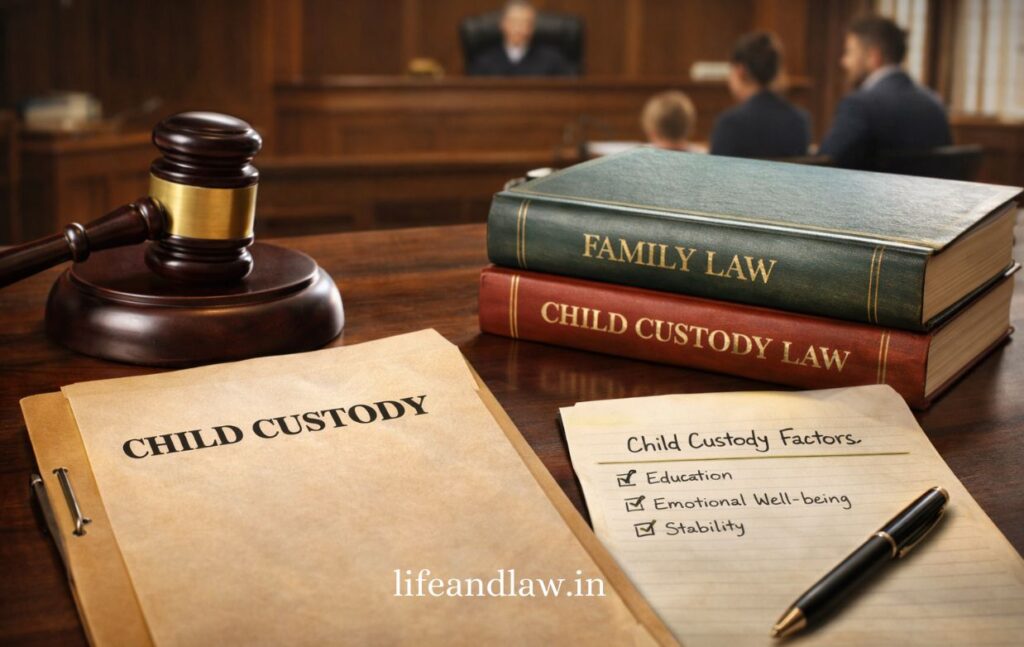
Courts consider a variety of issues before deciding custody. The age and gender of the kid are important, especially in cases involving infants or very young children. The emotional tie between the child and each parent is extremely important. Courts also consider the educational environment, continuity of education, and social stability.

The parents’ financial capacity is examined, although it is not decisive. Courts assess parents’ mental and physical health, as well as their character, behaviour, and capacity to offer a loving environment. A parent’s history of domestic violence, abuse, neglect, or substance misuse is particularly damaging. Finally, the court wants to make sure the youngster is stable, safe, and emotionally healthy.

Preference of the Child and In-Camera Interaction

Courts may take into account the wishes of a youngster who is old enough to express an educated preference. Judges frequently speak with children in-camera, away from their parents, to better understand their comfort and concerns. However, the child’s preferences are not considered final or binding.

Courts exercise caution to ensure that neither parent influences, coaches, or emotionally pressures the youngster. The aim of such engagement is to protect the child’s mental health and guarantee that their voice is heard while avoiding trauma.

Role of Mediation and Shared Parenting

In custody disputes, the Family Court aggressively encourages mediation and amicable settlement. Prolonged litigation might have a harmful impact on a child’s emotional health. Shared parenting agreements and parenting plans are becoming increasingly popular as practical solutions that allow both parents to stay actively involved in their children’s lives.

Joint custody and planned visitation patterns help to reduce conflict and enhance coparenting. Courts acknowledge that, in most situations, a kid benefits from both parents’ affection and supervision, assuming the setting is safe and stable.

Modification of Custody Orders

Custody orders are neither rigorous nor permanent. Courts maintain the authority to alter custody arrangements if circumstances change. Relocation, remarriage, changes in the child’s requirements, or evidence of neglect may all support a revision. This flexibility ensures that custody decisions are aligned with the child’s best interests.

Conclusion

Child custody judgements are among the most sensitive tasks of Indian courts, which prioritise the child’s wellbeing. Custody is concerned with providing a secure, caring, and healthy environment rather than gaining parental advantage.

Adv. Abdul Mulla emphasises these concepts on platforms such as www.lifeandlaw.in and www.asmlegalservices.in, highlighting that courts encourage parents to prioritise their children’s best interests before personal disagreements. Indian jurisprudence continues to take a balanced and humanitarian approach to protecting children’s rights and development.

RECENT POSTS

CATEGORIES

Leave a Reply

Your email address will not be published. Required fields are marked *

Life And Law Blogs

Life & law provides valuable insights by simplifying complex legal concepts and connecting them to real-life experiences …read more

Why I write

At Life & law, my mission is simple. to make the law accessible and empower people with knowledge to confidently face life’s challenges …read more

Copyright BlazeThemes. 2025