Loading ...

Life & Law

RECENT NEWS

Forests at Risk: Deforestation, Laws and Responsibility 

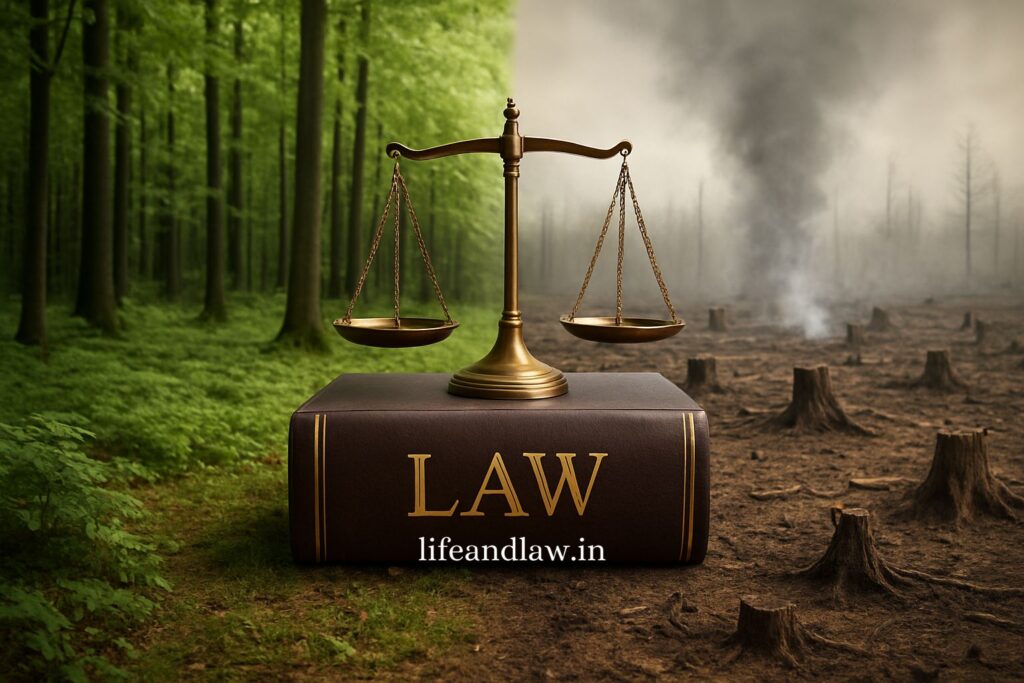
Forests are essential to human survival because they provide oxygen, regulate the climate, safeguard biodiversity, and support the water cycle. However, industrialisation, urbanisation, and illicit logging are rapidly diminishing global forest resources, resulting in a severe imbalance between destruction and conservation. This growing threat underlines the need for stricter legislation and more effective execution to protect forests.

The aim of this article is to look at the regulations that prohibit deforestation and who is responsible for effective forest protection. It considers the consequences of deforestation, the current legislative framework, its enforcement, and the shared responsibilities required to maintain forests for the future.

Relationship Between Deforestation and Food Security

The topic for International Day of Forests 2025 is “Forests and Food,” emphasising the role of forests in food security, nutrition, and livelihoods. Forests are more than just a part of the ecosystem; they are also critical sources of food security for humans. Many foods, including fruits, tubers, honey, spices, and medicinal plants, originate in woods. Forests are particularly important to tribal and rural communities. They get nutrition and income from forest-based items. However, rising deforestation has jeopardised this food source and biodiversity.

When forests are destroyed, edible plants and animals that live in them may disappear, posing serious concerns to food supply and nutritional security. Deforestation contributes to climate change, soil erosion, and agriculture, all of which have a detrimental impact on food security. As a result, the government, local communities, businesses, and residents must work together to maintain forests. Food security can only be sustained if forests persist, so everyone must take responsibility for forest protection. The concept of “Forests and Food” emphasises the importance of implementing sustainable alternatives and forest conservation.

Forest Conservation Laws and Policies in India

India has numerous laws and policies in place to protect forests and maintain food security. These laws’ primary goals are to avoid deforestation, preserve biodiversity, and safeguard the rights of local residents.

  1. Indian Forest Act (1927): This legislation was enacted to conserve and manage forest resources. It empowers the government to classify and manage forests. 
  2. Forest Conservation Act of 1980: This regulation governs the commercial and industrial uses of forests. Any type of deforestation requires clearance from the central government.
  3. Environment Protection Act (1986): This law was passed to maintain environmental balance and avoid pollution. It is critical in mitigating deforestation-related damage.
  4. Biological Diversity Act (2002): This law focuses on biodiversity conservation in India as well as protecting local communities’ rights. It is effective in safeguarding forest plants and animals.
  5. Forest Rights Act (2006): Tribal and local communities are granted forest land rights under this statute. Its primary aim is to defend the customary rights of people living in woods. 
  6. Local policies promoting food security and forest conservation; Several state governments have implemented special programs to conserve forests and ensure food security. These include community forest management plans, social forestry projects, and initiatives to encourage environmentally responsible farming techniques.

Whose Responsibility?

Forest conservation and food security are not solely the duty of the government; the entire society must collaborate and make efforts. Only when the government, industries, local communities, and citizens fulfil their respective roles will the goals of forest protection and food security be met.

  1. Government’s responsibility: The government must carefully enforce forest conservation laws, develop policies promoting sustainable agriculture, and safeguard the rights of local and indigenous groups. It must also put in place effective measures to promote environmental sustainability.
  2. Responsibility of Industries: CSR requires industries to minimise deforestation, manage natural resources responsibly, use environmentally friendly technologies, and implement forest conservation projects. Large corporations must prioritise sustainable development.
  3. The Role of Local and Indigenous Communities: Local and tribal communities are the natural caretakers of forests. They must use forests sustainably, comply with the Forest Rights Act, and actively participate in environmental conservation efforts.
  4. The Responsibility of Common Citizens: Common citizens must plant trees, stop illegal logging, live an environmentally healthy lifestyle, and actively participate in forest conservation initiatives. Even little actions can result in enormous effects.

Solutions for Preserving Food and Forests

• Promoting Sustainable Agriculture – Focus on organic farming, mixed cropping, and soil fertility.

• Controlling deforestation – Reduce unlawful deforestation, promote afforestation, and implement sustainable forest management.

• Reducing food waste – Use contemporary food storage systems, reduce food waste, and train farmers.

• Leading an eco-friendly lifestyle – Use locally sourced and organic foods, decrease your use of plastic, and plant trees.

• Involving local communities – Ensure that tribal and rural groups actively participate in forest conservation, and give financial aid from the government.

Conclusion

To prevent deforestation, the government, industries, local communities, and residents must work together. Strong law enforcement, sustainable farming, and environmentally conscious habits are critical for preserving forests, which support ecological balance, biodiversity, and food security.

The author, Adv. Abdul Mulla, who writes about legal and social issues on platforms such as www.asmlegalservices.in and www.lifeandlaw.in, emphasises the importance of responsible natural resource use and afforestation. Forest protection is more than just an environmental responsibility; it is also necessary for human survival.

RECENT POSTS

CATEGORIES

Leave a Reply

Your email address will not be published. Required fields are marked *

Life And Law Blogs

Life & law provides valuable insights by simplifying complex legal concepts and connecting them to real-life experiences …read more

Why I write

At Life & law, my mission is simple. to make the law accessible and empower people with knowledge to confidently face life’s challenges …read more

Copyright BlazeThemes. 2025