Trending
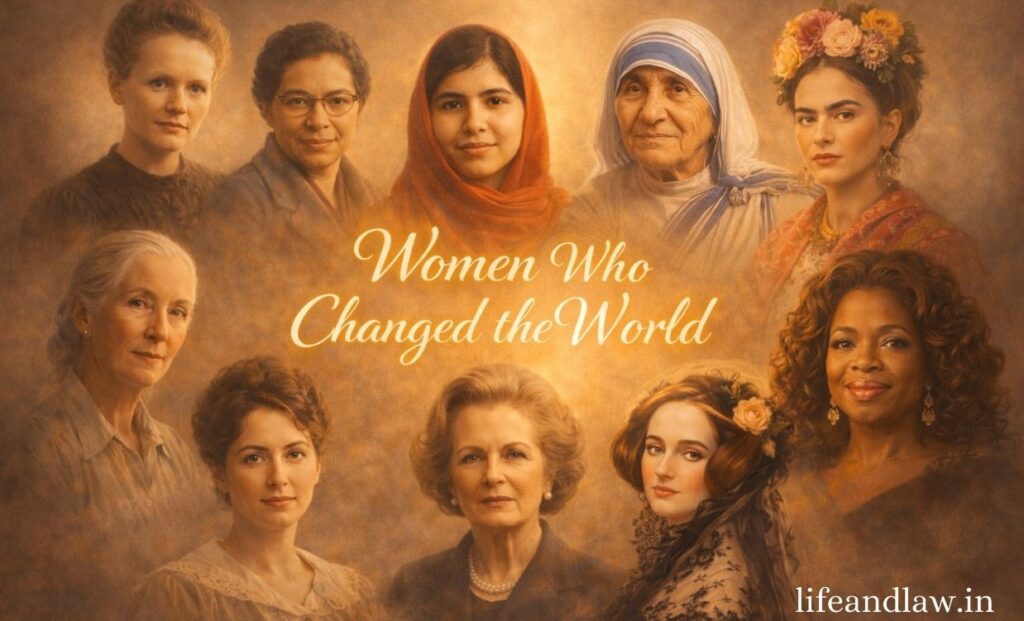
Throughout history, women have played crucial roles in shaping human development in science, politics, art, and social justice. These trailblazers often worked against profoundly ingrained barriers of prejudice and exclusion, transforming personal suffering into long-term global impact. Their stories show us how courage, resilience, and conviction can disrupt the current quo and redefine what is possible.
This article follows the adventures of ten amazing women whose ideas and actions altered the course of history. From laboratories and courtrooms to streets, studios, and classrooms, these women not only knocked down barriers, but also inspired future generations to dream large and act boldly.
Marie Curie’s revolutionary research into radioactivity transformed science. She discovered the elements polonium and radium, invented methods for isolating radioactive isotopes, and lay the groundwork for contemporary atomic physics. Her work revolutionised medical science, resulting in X-ray technology, radiotherapy for cancer, and advances in nuclear medicine. Curie was the first woman to get a Nobel Prize and is still the only person to have received two Nobel Prizes in two different scientific fields—Physics and Chemistry—thereby confirming her position as a scientific pioneer.
Rosa Parks’ refusal to give up her bus seat in 1955 triggered the Montgomery Bus Boycott, a watershed incident in the American Civil Rights Movement. The 381-day boycott highlighted the power of nonviolent resistance and collective action, resulting in the desegregation of public transportation. Parks’ quiet courage inspired nationwide efforts to end racial segregation in school, employment, and voting rights, giving her the title “Mother of the Civil Rights Movement.”
Malala Yousafzai’s fight for girls’ education established her as a global figure of perseverance. After surviving a Taliban assassination attempt at the age of 15, she redoubled her efforts to promote educational rights. In 2014, she became the youngest Nobel Peace Prize winner. Through the Malala Fund, she has impacted legislative reforms, sponsored education initiatives around the world, and raised the voices of girls who have been denied the opportunity to attend school.
Mother Teresa dedicated her life to helping the poorest of the impoverished. She started the Missionaries of Charity in 1950, and it has grown into a global organisation that cares for the sick, orphans, and dying. Her work in Calcutta’s slums exemplified compassion via action. She won the Nobel Peace Prize in 1979, demonstrating how empathy-based service can be a strong force for peace and human dignity.
Frida Kahlo turned art into a statement of identity, pain, and struggle. Her surrealist self-portraits combined Mexican folk art with intensely personal symbolism, defying traditional beauty and gender stereotypes. Kahlo became an iconic figure in the feminist and LGBTQ+ movements by embracing her physical characteristics and cultural roots. Her work continues to have a global impact on art, fashion, and social conversation.
Jane Goodall’s long-term research of chimpanzees in Tanzania transformed scientific understanding of primates. Her discovery of tool use, hunting behaviour, and intricate social systems called into question traditional notions about the human–animal distinction. Beyond research, Goodall became a global environmental campaigner, establishing the Jane Goodall Institute and motivating future generations to safeguard species and habitats.
Margaret Thatcher made history as the United Kingdom’s first female Prime Minister. Her leadership transformed British politics and economics through privatisation, deregulation, and free-market reforms. Internationally, her robust foreign policy stance altered Cold War dynamics and bolstered global alliances. Despite the controversy, her tenure demonstrated that women could lead decisively at the highest levels of political power.
Oprah Winfrey’s journey from struggle to global impact shows the power of storytelling. The Oprah Winfrey Show and her media empire revolutionised television and public discourse. Her humanitarian endeavours, which encourage literacy, education, and disaster assistance, have benefited millions of people throughout the world. Oprah’s work demonstrates how influence, when combined with purpose, may lead to significant social change.
In 1921, Marie Stopes opened Britain’s first birth control clinic, transforming reproductive health. Through her clinics and important writings, she addressed sexual and family planning taboos, encouraging women to make educated reproductive decisions. Her work paved the way for contemporary sexual health services and global reproductive rights initiatives.
Ada Lovelace predicted the future of computing much before contemporary computers existed. She is regarded as the world’s first computer programmer after working with Charles Babbage to create the first algorithm intended for a machine. Her insights into computing’s creative possibilities continue to motivate women in STEM today.
The lives of these 10 women show how intelligence, courage, and perseverance can change history. Their tales demonstrate that substantial change frequently begins with a single person who is willing to question injustice and imagine a more equitable, inclusive society.
Adv. Abdul Mulla‘s concluding thought parallels topics covered in his legal writings on platforms such as www.lifeandlaw.in and www.asmlegalservices.in, emphasising the importance of purpose in progress and the responsibility of each generation to advance justice and equality.
Adv. Abdul Mulla (Mob. No. 937 007 2022) is a seasoned legal professional with over 18 years of experience in advocacy, specializing in diverse areas of law, including Real Estate and Property Law, Matrimonial and Divorce Matters, Litigation and Dispute Resolution, and Will and Succession Planning. read more….
Copyright BlazeThemes. 2025