Loading ...

Life & Law

RECENT NEWS

Jallianwala Bagh Massacre: A Dark Day in History

Some events in India’s freedom movement pierce the people’s hearts and awaken their thoughts. One of these is the terrible massacre that occurred on April 13, 1919, at Jallianwala Bagh in Amritsar. On the hallowed day of Baisakhi, British military officer General Dyer opened fire without warning on hundreds of innocent Indian men, women, and children. This horrific crime resulted in hundreds of deaths and numerous injuries. This act rocked the entire country and fuelled animosity against British control.

The Jallianwala Bagh massacre was more than just a horrible tragedy; it was a watershed moment that permanently shaped the unrest that had been festering in the minds of the Indian people. Following the massacre, the freedom struggle gained strength, and Mahatma Gandhi called for the Non-Cooperation struggle. The aim of this article is to assist readers comprehend the circumstances behind this massacre.

Background of the massacre

To comprehend the context of the massacre, it is crucial to understand the political climate of 1919. Following the First World War, there was a surge of unrest in India. The British administration received support from India during the war, but the people’s expectations for freedom were not met. Instead, the government enacted the “Rowlatt Act,” which authorised British police to arrest and detain any Indian resident without a warrant or trial. This law was strongly opposed across the country, and protests erupted in numerous locations.

In Punjab, the opposition was particularly strong. Satyapal and Saifuddin Kitchlew, nationalist leaders in Amritsar, were arrested, sparking protests from an incensed mob. The British administration had declared martial law in Punjab, prohibiting peaceful gatherings of people.

April 13, 1919: The Massacre

Baisakhi, a prominent festival celebrated in Punjab and North India, took place on April 13, 1919. On that day, many individuals, including men, women, the elderly, and young children, congregated in Amritsar’s Jallianwala Bagh for a peaceful meeting. The major aim of this assembly was to condemn the Rowlatt Act, to advocate for the release of the arrested patriotic leaders, and to support the concept of freedom. But the garden was encircled by buildings, with only one tiny escape. The folks gathering had no weapons and no intention of engaging in violence.

At this exact moment, British military officer General Reginald Dyer appeared in the lawn with his armed soldiers. He gave no warning and ordered the firing. Continuous firing lasted about ten minutes, with approximately 1,650 bullets fired. There was no safe way to leave the garden. People plunged into the well to save their lives, but hundreds were killed and many injured. Locals reported that more deaths occurred than government data indicated. This act fuelled Indians’ desire to rise up against tyranny even more.

Response After the Massacre

Following the Jallianwala Bagh slaughter, a wave of outrage surged across India. This brutal deed exposed the true face of British ruthlessness towards the people. Following this occurrence, Mahatma Gandhi called for the Non-Cooperation Movement. Many politicians around the country have fiercely opposed the British government. People boycotted British goods, abandoned schools and universities, and bolstered the Swadeshi movement. Following this episode, India’s freedom struggle took a new turn, with people fighting not only for rights but for complete self-rule.

The incident elicited significant emotions from around the world. Even in England, some authorities criticised General Dyer’s actions, while others defended him. The Hunter Commission was created to investigate the incident, however its report was insufficient and biassed. The Indian people did not receive justice, but the event boosted their sense of solidarity, self-esteem, and patriotism. Jallianwala Bagh became not only a historical site, but also an inspiration to the martyrs of the independence movement.

Jallianwala Bagh Memorial

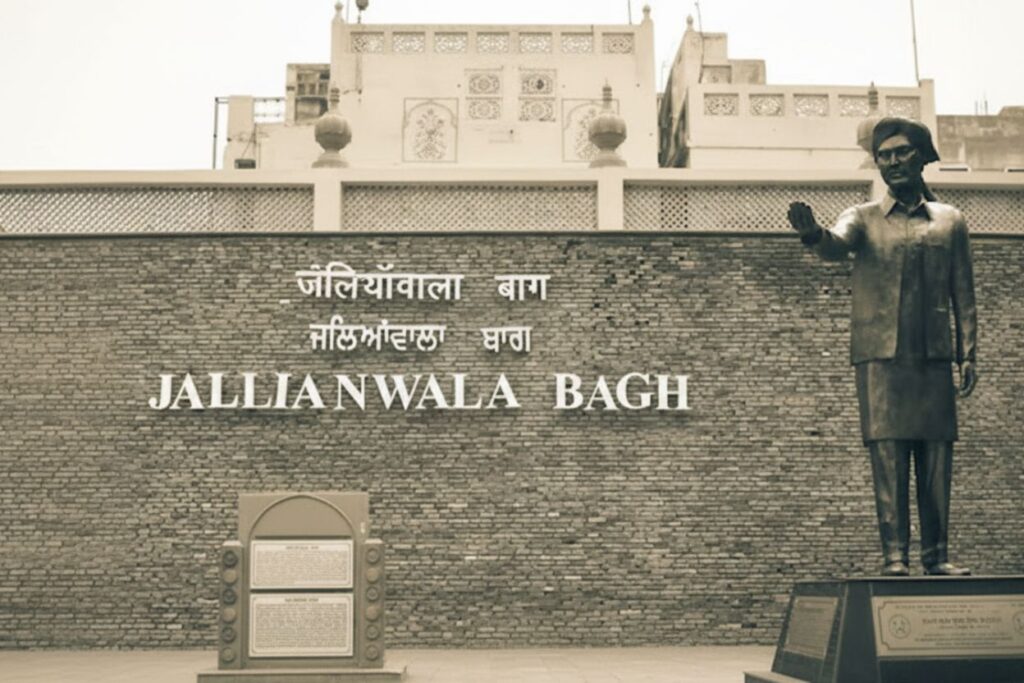
The Jallianwala Bagh memorial is a poignant reminder of that sad day in India’s liberation movement. The garden now enjoys the status of a national monument. The intact ruins of the fire positions, bullet marks, and the well are still visible here. The well in the centre of the garden, into which hundreds of innocent people jumped to save their lives, is still there. A Flame of Liberty has also been built here, as a permanent memorial of the martyrs’ sacrifices.

Even today, thousands of tourists, students, and history buffs visit this garden to relive the tragic events of that day. This location has become a repository of knowledge and inspiration throughout the history of India’s liberation movement. The Government of India has also begun a light and sound performance here, which vividly depicts the events of that day through sights and sound. This memorial reminds every Indian that freedom did not come easily—it required the sacrifice and valour of thousands of heroic patriots.

Conclusion

The Jallianwala Bagh massacre remains a harrowing yet crucial incident in India’s liberation fight, unsettling the country and strengthening opposition to British rule. General Dyer’s actions bolstered the Non-Cooperation and Swaraj movements, reminding future generations of the cost of liberty.

Adv. Abdul Mulla‘s articles on www.lifeandlaw.in  and  www.asmlegalservices.in demonstrate how such historical events continue to impact public awareness, shared memory, and the values that shape civic responsibility within legal and ethical constraints.

RECENT POSTS

CATEGORIES

Leave a Reply

Your email address will not be published. Required fields are marked *

Life And Law Blogs

Life & law provides valuable insights by simplifying complex legal concepts and connecting them to real-life experiences …read more

Why I write

At Life & law, my mission is simple. to make the law accessible and empower people with knowledge to confidently face life’s challenges …read more

Copyright BlazeThemes. 2025