Trending
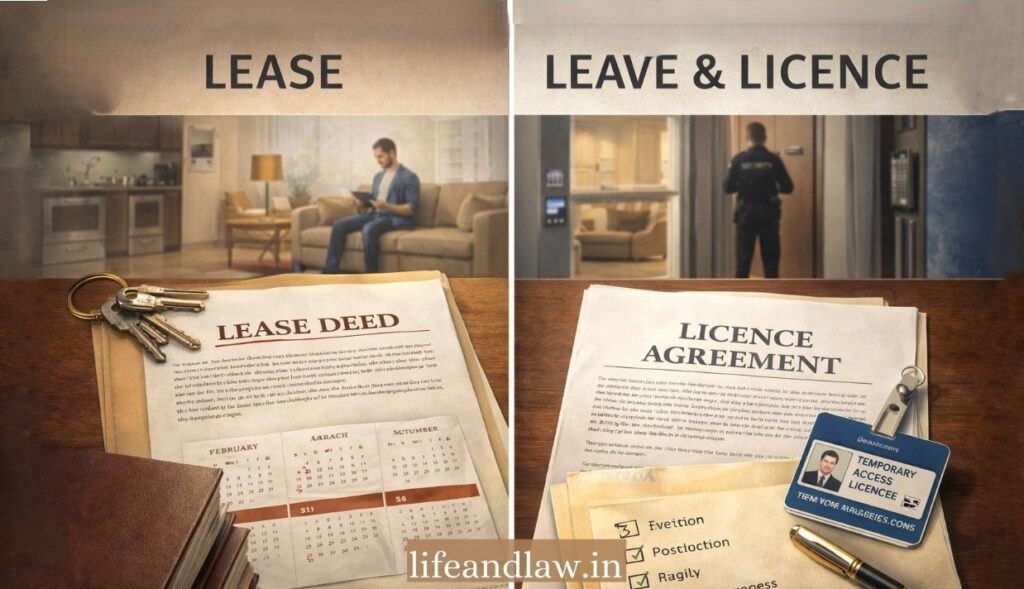
With rapid urbanisation and rising demand for residential and commercial space, property owners in India frequently allow others to occupy their properties for consideration. A common legal error is failing to distinguish between a lease and a leave and licence agreement. While both grant possession or use of property, they follow different legal principles and have distinct rights, liabilities, and hazards.
The aim of this article is to illustrate the fundamental differences between a lease and a leave and licence, allowing property owners to make informed decisions while avoiding potential disputes or loss of control over their property.
Section 52 of the Indian Easements Act, 1882, governs leave and licensing arrangements. Unlike a lease, a licence creates no stake in the property. It is just a permission provided by the owner (licensor) to another person (licensee) to use the property for a defined purpose and time. The licensee’s right is personal and does not constitute possession in the legal sense.
In a leave and licence agreement, the licensor maintains legal custody and control over the premises. The licensee cannot exercise tenancy rights, nor can the licence be transferred or inherited. This arrangement is frequently utilized for short-term employment due to its flexibility and ease of termination.
The transfer of interest is the key distinction between a lease and a leave and licence. A lease transfers a right to the property, whereas a licence just grants the right to use the property without any ownership interest. Exclusive possession is a major indicator of a lease, although it is not conclusive in itself.
Another important distinction is revocability. A lease can only be cancelled in line with the terms of the agreement and applicable regulations, whereas a licence is typically revocable unless accompanied by a grant. Courts routinely adopt the concept of substance over form, which means that the essence of the agreement is determined by the parties’ true intention and actual activity, not just the title assigned to it.
Registration is an important factor in evaluating the enforceability of property agreements. Leases of more than eleven months must be registered and the relevant stamp duty paid. An unregistered lease deed may cause legal issues and the inability to enforce contractual rights.
Leave and licence agreements are also subject to stamp duty and registration, especially in places such as Maharashtra, where registration is required regardless of term. Proper compliance ensures legal clarity and avoids future conflicts over possession or termination.
The Transfer of Property Act governs lease termination and requires the issuance of a legal notice, unless otherwise agreed upon in the contract. Eviction of a lessee typically entails civil court actions and, in some situations, compliance with rent control legislation, which can be time-consuming.
Terminating a leave of absence and licence, on the other hand, is more easy. When the licence expires or is revoked, the licensee must evacuate the premises. Several state laws enable brief eviction proceedings for licensees, making this structure desirable for owners who want flexibility and control.
In a lease, the lessee is entitled to peaceful use of the property, while the lessor is required to ensure lawful possession. Subject to agreement, lessees may sublet or assign their interest. Maintenance duties are frequently split or established contractually.
In a leave and licence agreement, the licensee’s rights are narrowly confined to the approved usage. Subletting is not permitted, and the licensor maintains greater control over the property. The arrangement’s impermanent and permissive nature is reinforced by the fact that licence fees are paid instead of rent.
Courts in India have frequently underlined that simply labelling an agreement as a “licence” does not preclude it from being construed as a lease if exclusive possession and other conditions exist. Property owners frequently employ leave and licence agreements to bypass tenancy rules, but faulty draughting might undermine this goal.
To avoid disagreements, careful draughting, clarity of intention, and statutory conformity are required. Before deciding on an acceptable agreement, property owners must consider the duration, level of control, and risk exposure.
Understanding the difference between a lease and a leave and license is critical to preserving property rights. Each arrangement is governed by a distinct legal framework, with various implications for possession, control, and obligations.
Adv. Abdul Mulla discusses these issues on platforms such as www.lifeandlaw.in and www.asmlegalservices.in, highlighting the importance of property owners thoroughly considering their intentions and legal implications before providing occupation. Informed judgements assist to avoid problems, make arrangements run more smoothly, and protect ownership interests.
Adv. Abdul Mulla (Mob. No. 937 007 2022) is a seasoned legal professional with over 18 years of experience in advocacy, specializing in diverse areas of law, including Real Estate and Property Law, Matrimonial and Divorce Matters, Litigation and Dispute Resolution, and Will and Succession Planning. read more….
Copyright BlazeThemes. 2025