Trending
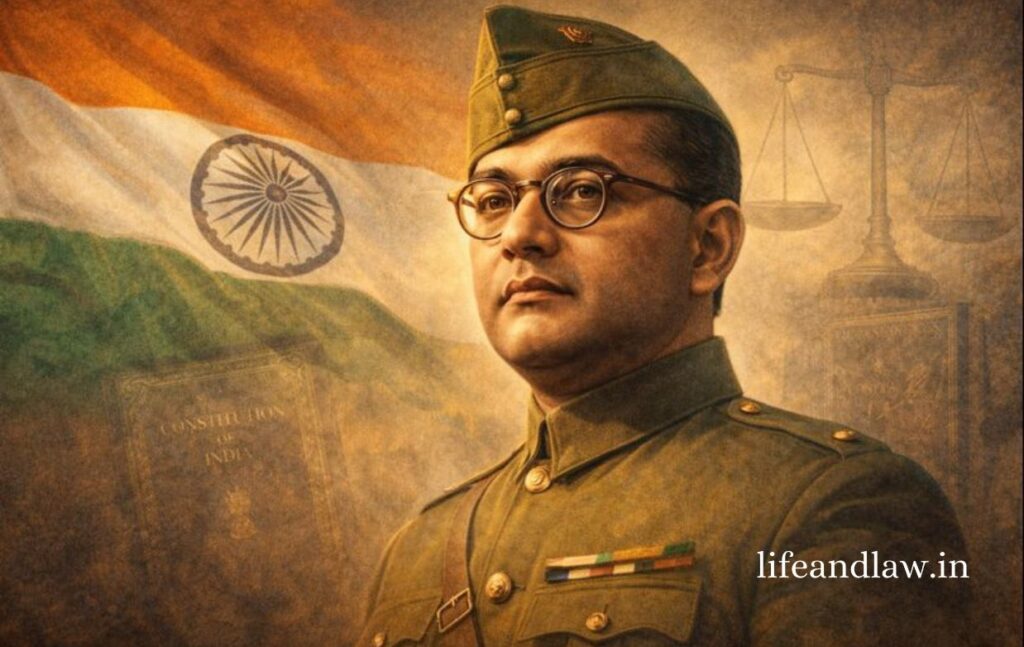
On January 23, India honours the birth anniversary of Netaji Subhas Chandra Bose, one of the most steadfast and unwavering leaders of the Indian independence movement. Netaji was born on January 23, 1897, and his life represents heroism, sacrifice, and an unwavering devotion to India’s complete independence. The Government of India celebrates his birth anniversary as Parakram Diwas, recognising his tremendous bravery and leadership.
While Netaji Subhas Chandra Bose is best known for his revolutionary role and leadership of the Indian National Army (INA), his theories have had a long-lasting impact on Indian political philosophy and legal consciousness. His vision of sovereignty, equality, discipline, and social justice lives on in modern India’s constitutional and legal frameworks.
Subhas Chandra Bose was born in Cuttack, Odisha, to a well-educated Bengali family. His father, Janakinath Bose, was a distinguished lawyer, therefore Subhas was exposed to legal reasoning, public affairs, and political discourse at a young age. Bose, a superb student, graduated from Presidency College in Calcutta before travelling to England and passing the Indian Civil Services (ICS) examination in 1920.
However, Bose took a key moral and political decision by resigning from the ICS and refusing to serve the British colonial administration. This conduct demonstrated his firm belief that independence could not be realised by collaboration with colonial power. Bose, influenced by nationalist intellectuals and India’s burgeoning resistance movement, believed that political freedom was inextricably linked to dignity, self-respect, and national honour.
Unlike many other leaders of his day, Netaji openly questioned the efficacy of constitutional reforms and nonviolent struggle as the main ways of achieving liberation. Although Bose admired Mahatma Gandhi, he believed that British imperialism would not quit quietly without a strong fight. For him, freedom was a right that needed to be expressed rather than a concession to be negotiated.
This ideological split prompted his departure as President of the Indian National Congress in 1939, ushering in a more extreme phase of his battle.
Bose staged a daring escape from British surveillance in India in 1941, travelling through Europe and then Southeast Asia. With the help of Indian prisoners of war and expatriates, he reorganised and headed the Indian National Army (Azad Hind Fauj).
The INA was founded on the belief that Indians should struggle for their own liberation. Netaji’s famous exhortation — “Give me blood, and I will give you freedom” – summed up his belief in sacrifice, discipline, and community responsibility. In 1943, he also founded the Provisional Government of Free India (Azad Hind Government), asserting India’s right to sovereign statehood before independence.
One of Netaji’s most revolutionary initiatives was the formation of the Rani of Jhansi Regiment, the INA’s all-female military regiment. At a time when women were primarily barred from military service, this move represented his strong belief in gender equality and women’s active engagement in nation-building.
Although Netaji Subhas Chandra Bose was not personally involved in the drafting of the Indian Constitution, his political theory had a profound impact on the larger national discourse that established India’s legal foundations.
Netaji continuously argued for complete independence (Purna Swaraj). This uncompromising approach is reflected in the Preamble to the Indian Constitution, which declares India to be a sovereign republic. His rejection of dominion status and colonial subjugation emphasised the concept that political authority must stem only from the will of the people.
Bose imagined an India free of bigotry and exploitation. His emphasis on equality, unity, and social justice is consistent with the Fundamental Rights guaranteed by Part III of the Constitution, particularly equality before the law, non-discrimination, and the protection of individual liberty.
Netaji held that political freedom was useless without economic and social justice. His beliefs on state-led development, national planning, and welfare policies are consistent with the Directive Principles of State Policy, which guide the state in promoting social and economic equality, securing livelihoods, and reducing inequities.
Netaji Subhas Chandra Bose is still one of the most beloved and controversial characters in Indian history. His strategic partnership with the Axis nations during World War II is frequently criticised, but it must be considered in light of his single goal: India’s independence from British dominion.
The circumstances surrounding his death in 1945, purportedly in a plane crash in Taiwan, have sparked extensive public debate and investigation. Despite these controversies, his status as a national hero remains intact.
His mantras “Jai Hind” and “Dilli Chalo” continue to instill patriotism, discipline, and national pride. Today, Netaji’s principles are still significant in disputes about constitutional morality, national sovereignty, and the rule of law.
Netaji Subhas Chandra Bose was not only a revolutionary freedom warrior, but also a visionary who thought that true independence is founded on fairness, equality, discipline, and moral accountability. His life shows us that freedom is perpetuated not only through political strength, but also through steadfast adherence to constitutional and ethical norms.
As we commemorate Parakram Diwas, Netaji’s principles continue to inspire thoughts about law, democracy, and national dignity. Adv. Abdul Mulla engages with these enduring ideas in an educational and reflective manner by writing about legal awareness and constitutional values on platforms such as www.lifeandlaw.in and www.asmlegalservices.in.
Adv. Abdul Mulla (Mob. No. 937 007 2022) is a seasoned legal professional with over 18 years of experience in advocacy, specializing in diverse areas of law, including Real Estate and Property Law, Matrimonial and Divorce Matters, Litigation and Dispute Resolution, and Will and Succession Planning. read more….
Copyright BlazeThemes. 2025