Loading ...

Life & Law

RECENT NEWS

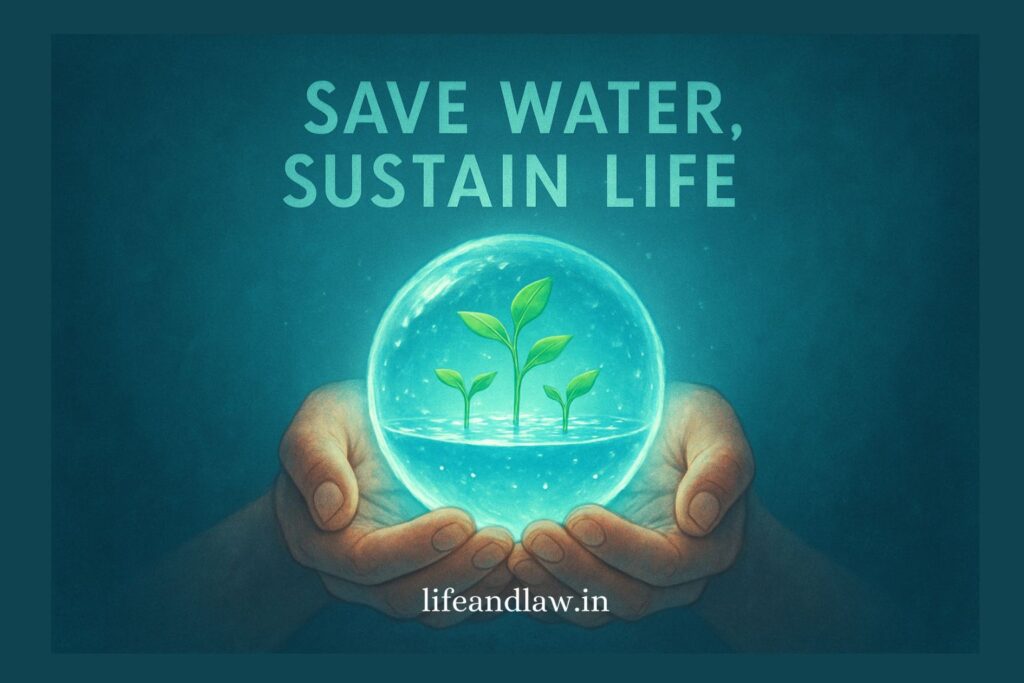
Save Water, Sustain Life: Conservation & Solutions

Water is the basis of life, necessary for the survival of all living things. However, fast population expansion, industrialisation, urbanisation, and climate change are putting enormous strain on global water supplies, resulting in increased water shortages in many countries. This situation shows the critical necessity to recognise the worth of water and promote its conservation.

The aim of this article is to raise awareness about the sustainable use of water, propose practical solutions to reduce waste, and urge governments, organisations, and individuals to take effective action. It also suggests viable strategies for avoiding future water scarcity and ensuring long-term security.

History and Importance of World Water Day

Every year the world celebrates World Water Day. Its origins can be traced back to the 1992 United Nations Conference on Environment and Development (UNCED) in Rio de Janeiro, Brazil. This day has been officially observed around the world since 1993, thanks to a decision made by the United Nations. The primary aim of this day is to raise public awareness about water conservation and to attract attention to the issues surrounding the supply of clean water.

The topic of World Water Day 2025 is “Glacier Preservation.” This is a highly important issue since glaciers contain a significant amount of the world’s freshwater supplies and are critical components of the water cycle. Glaciers are melting at a rapid pace as a result of rising temperatures and climate change, producing major problems such as water scarcity, flooding, and rising sea levels. As a result, the theme for this year’s Water Day will be glacier preservation and climate change mitigation.

Major Causes of Water Scarcity

Increasing population — Increased consumption puts tremendous strain on water resources.

Industrialisation and urbanisation — The rise of businesses and cities results in an excessive extraction of water resources.

• Water pollution — Industrial trash, plastic, and sewage pollute rivers, reducing the amount of pure water.

• Climate Change — Irregular rainfall, droughts, and rising temperatures all disturb the water system.

• Poor water management — Water waste and poor management of water resources exacerbate scarcity.

Need for Water Conservation

Water is the most important natural resource on Earth. Water conservation entails using and storing water carefully in order to preserve it for future generations. Water availability is decreasing as the world’s population grows and climate change worsens. As a result, everyone, including the government, should strive to save water.

1.The need to preserve water for future generations

Nowadays, a lot of water is wasted. If water supplies are not properly conserved and recharged, future generations will confront significant water scarcity. Therefore, rainwater harvesting, reuse, and appropriate water consumption are vital.

2.The role of water in maintaining environmental balance

Water is an essential component for preserving environmental equilibrium. Plants and animals rely on rivers, lakes, and groundwater for survival. If water supplies are destroyed or polluted, the ecological chain (ecosystem) could collapse.

3.Water is essential for food security and the agricultural sector

Agriculture is India’s principal occupation, and it relies greatly on water. Water scarcity affects agricultural production, putting food security at risk. As a result, farmers must implement drip irrigation, water saving methods, and sophisticated water management procedures.

Measures for Water Conservation

To address the issue of water scarcity, water conservation measures must be implemented at all levels. Water conservation is not solely dependent on government laws; individuals at the home, agricultural, and industrial sectors must utilise water wisely.

  • Household-level measures

Use a bucket and mug instead of a shower for bathing.

Use only the necessary amount of water when cleaning kitchenware and clothing.

Maintain taps and pipelines periodically to prevent leaks.

Boost groundwater levels via rainwater gathering.

  • Measures in the agricultural sector

Utilise current technology like drip irrigation and sprinkler systems.

Adopt water-saving crop patterns.

Conserve traditional water sources such as lakes, wells, and bunds.

Use mulching strategies to keep soil hydrated.

  • Measures in the industrial sector

Prioritise reuse and recycling in production operations.

Sewage water should be treated to reduce pollution and reused.

Conduct water-literacy initiatives in industries to promote responsible water use.

  • Traditional and modern water-conservation methods

Restore traditional water sources like lakes, wells, and bunds.

Rejuvenate and conserve rivers.

Increase groundwater sources by large-scale tree planting.

Use water-purification technology to make water safe for reuse.

Conclusion

Water is necessary for life, and its conservation is becoming increasingly important as population increase, industrial development, and climate change put a strain on world water resources. Effective measures such as tree planting, responsible water use, groundwater recharge, and water body restoration are required to maintain this critical resource.

The author, Adv. Abdul Mulla, who writes about legal and social concerns for platforms such as www.asmlegalservices.in and www.lifeandlaw.in, emphasises collective responsibility. We can assist avert future water scarcity by implementing mindful water-conservation habits on an individual and social scale.

RECENT POSTS

CATEGORIES

Leave a Reply

Your email address will not be published. Required fields are marked *

Life And Law Blogs

Life & law provides valuable insights by simplifying complex legal concepts and connecting them to real-life experiences …read more

Why I write

At Life & law, my mission is simple. to make the law accessible and empower people with knowledge to confidently face life’s challenges …read more

Copyright BlazeThemes. 2025