Trending
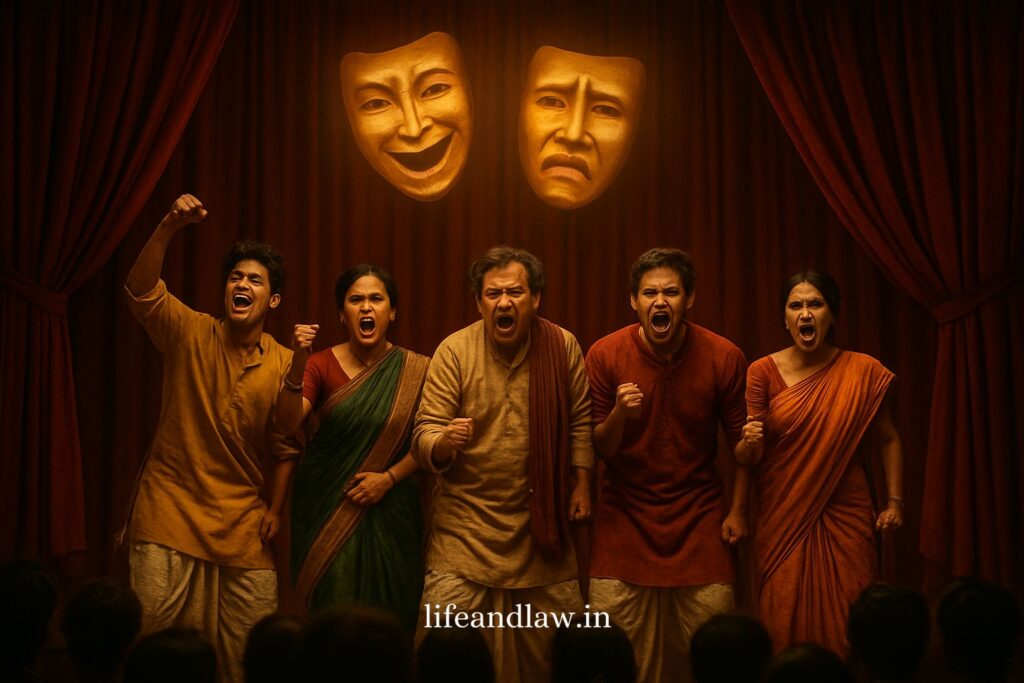
Theatre reflects society and serves not just as an entertainment medium but also as a forum for intellectual and social discourse. Artists use drama, dance, and performance to explore political, cultural, and human issues. Censorship, legal limitations, and social pressures frequently undermine freedom of expression on stage, jeopardising theatre practitioners’ creative liberty.
Although freedom of expression is a constitutional right in India, plays frequently encounter prohibitions, complaints, and censorship, especially on sensitive social, political, or religious issues. The aim of this article is to emphasise the importance of artistic freedom in theatre and investigate the legal constraints that influence it.
Every year we commemorate World Theatre Day. It was developed by UNESCO’s International Theatre Institute (ITI) in 1961. The primary aim of this day is to promote and propagate theatrical art on a global scale, inspire theatre workers and artists, and transmit social concerns through plays. Theatre is more than just a kind of entertainment; it is also a powerful vehicle for social change.
Drama has always served as a powerful means of communicating human thoughts, feelings, and societal critique. Various theatre traditions, including India’s Sanskrit theatre tradition (Bharat Muni’s “Natyashastra”), Marathi theatre, Parsi theatre, and folk theatre (Tamasha, Kirtan, Dashavatara), have addressed societal themes, political circumstances, and personal conflicts. Playwrights and directors utilise theatre to expose issues such as political injustice, socioeconomic inequality, casteism, gender discrimination, and corruption.
Article 19(1)(a) of the Indian Constitution states that every citizen has the fundamental right to free expression. This means that anyone can freely communicate their views, feelings, opinions, and beliefs. This independence can also be conveyed through theatre, film, writing, art, music, and media. As a result, this right benefits theatrical performers, authors, and directors alike. However, freedom of expression is not entirely unrestricted. According to Article 19(2) of the Indian Constitution, the government has the ability to impose particular restrictions under specified conditions.
Security of the State
If a performance constitutes a threat to national security, has the potential to instigate violence, or could spark a riot, the government may impose limits on it.
Friendly relations with foreign states
Any artwork that could jeopardise diplomatic relations between India and other countries cannot be displayed on stage. If a play has the potential to influence India’s foreign policy, restrictions may be enforced.
Public order
The government may prohibit any play or performance that threatens peace, causes disruption, or encourages violence.
Decency or Morality
Obscene, perverse, or morally offensive scenes may be prohibited by law. These plays can be censored.
Contempt of court
Any play that disrespects judicial authority or constitutes contempt of court cannot be presented.
Defamation
If a play makes false charges about a person or entity, legal action may be initiated against the theatrical production.
The sovereignty and integrity of India
Any theatrical production that undermines national sovereignty, promotes anti-national propaganda, or advocates separatist beliefs is subject to legal prohibitions.
Incitement to an Offence (Hate Speech, Religious Disharmony)
Any artwork that incites religious strife, offends religious emotions in any society, or promotes hatred is not permitted on stage.
Indian theatre has served as a significant vehicle for social transformation, political criticism, and intellectual discourse, in addition to providing enjoyment. Many playwrights have used their plays to speak out against injustice, political situations, and constraints on human freedom. However, their expression has frequently been censored, banned, or threatened.
Vijay Tendulkar’s plays on the Marathi stage boldly depict severe societal realities. His play “Sakharam Binder” sparked widespread outrage owing to its harsh indictment of sexual freedom and patriarchal beliefs. Similarly, “Ghashiram Kotwal” was rejected because it harmed the reputation of historical persons. Girish Karnad’s plays, including “Tughlaq” and “Hayavadana,” explored power, identity, and societal paradoxes.
Habib Tanvir created plays that addressed social themes through folk art. His play “Charandas Chor” was a commentary on systemic corruption and hypocrisy. Safdar Hashmi, the founder of Jan Natya Manch (JANAM), spoke out against injustice and for workers’ rights in the play “Halla Bol,” but he was assassinated by goons in 1989.
Experimental theatre also contributed significantly to the protection of free expression. It tackled contentious political and social issues, faced restrictions, and prompted viewers to think. Freedom of expression in theatre is not only a legal concern, but it is also linked to societal values and intellectual freedom. Playwrights have struggled against constraints to safeguard their artistic expression.
Theatre is a means for raising social consciousness, with playwrights highlighting injustice and human rights despite legal and social constraints. Artists continue to convey realistic narratives, preserving intellectual independence on stage.
As Adv. Abdul Mulla frequently emphasises in his writings on sites such as www.asmlegalservices.in and www.lifeandlaw.in, sustaining artistic expression is critical for society. Freedom on stage is not only an artist’s prerogative, but also the responsibility of all citizens.
Adv. Abdul Mulla (Mob. No. 937 007 2022) is a seasoned legal professional with over 18 years of experience in advocacy, specializing in diverse areas of law, including Real Estate and Property Law, Matrimonial and Divorce Matters, Litigation and Dispute Resolution, and Will and Succession Planning. read more….
Copyright BlazeThemes. 2025