Trending
Death is an unavoidable aspect of life, but it frequently presents emotional and legal issues to the surviving family members. A major worry in such cases is deciding who will inherit the deceased’s property and assets. In India, legal heirship is governed by a variety of laws depending on religion, whether the deceased left a will, and the nature of the assets.
This article seeks to clarify legal heirship by explaining the relevant inheritance laws and practices. Understanding these criteria allows families to ensure that the deceased’s estate is distributed properly and in accordance with legal requirements.
Legal heirship is the right of an individual to inherit the property, assets, and belongings of a deceased family member in accordance with legal rules. The term “legal heir” refers to those individuals who are legally entitled to inherit the deceased’s property, particularly when there is no will (testament). In the absence of a testament, assets are distributed according to the norms of intestate succession, which differ across Hindus, Muslims, Christians, and other Indian cultures.
When a person dies without leaving a will, the property is divided according to the principles of intestate succession, as prescribed by personal laws. Here’s an overview of how this works in different communities:
The Hindu Succession Act divides the property of a deceased Hindu, Sikh, Buddhist, or Jain among lawful successors, which include the spouse, children, and, in some cases, parents. Heirs fall into two categories:
Class I Heirs: These include the deceased’s children (son and daughter), wife, mother, and other immediate family members, who share the estate equally.
Class II heirs: If there are no Class I heirs, the property transfers to Class II heirs, which include the father, siblings, and their descendants.
Testamentary succession: If the deceased left a valid will, the property is dispersed according to the will’s directions.
For Muslims, inheritance is governed by personal laws derived from the Quran. Legal heirs are defined as follows:
Shia Law: The inheritance is divided into portions according to Shia laws.
Sunni Law: The estate is shared among the surviving family members, including the spouse, children, and parents. Each heir’s portion is predetermined, and distribution may differ depending on the gender of the heirs. A Muslim woman’s portion is normally half that of a male heir.
Christians in India observe the Indian Succession Act of 1925. In intestate succession, property is divided among the surviving spouse, children, and parents. If the deceased had children, the inheritance is split evenly between the husband and the children.
Individuals married under the Special Marriage Act (for interreligious weddings) are subject to inheritance laws based on the deceased’s personal law, which allows the spouse to inherit property even in interfaith marriages.
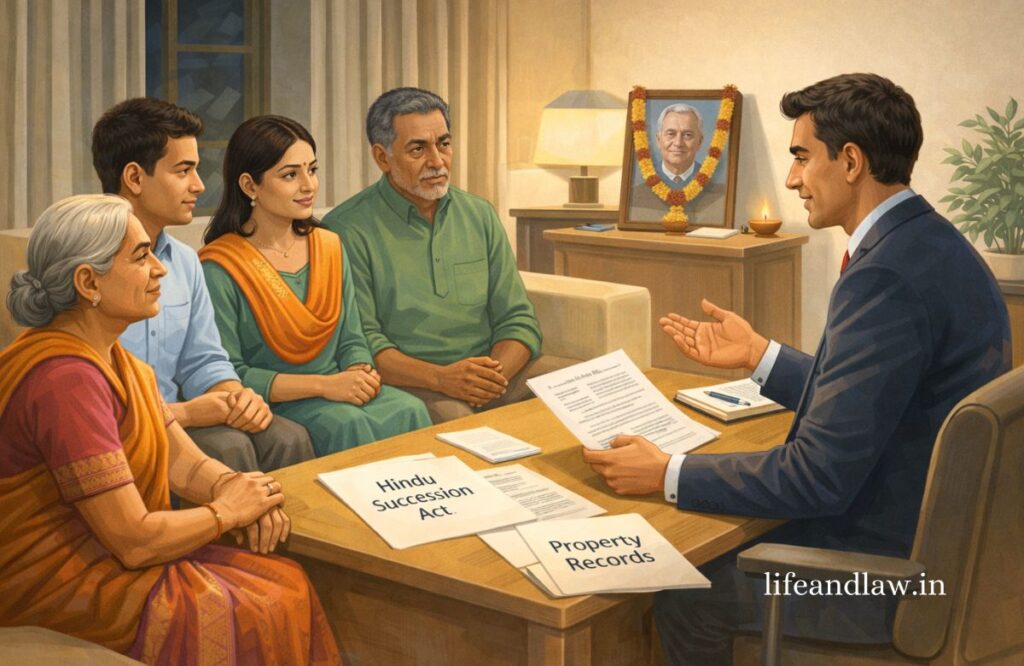
If a person dies with a will, the process of inheritance is called testamentary succession. A will states how the deceased’s assets should be allocated among the beneficiaries. In such circumstances, the legal heirs are those identified in the will, and the assets are dispersed in accordance with the deceased’s desires.
However, the legitimacy of the will must be determined in court. This entails a process known as probate, in which the will is recognised and an executor is appointed to carry out the contents of the will. If a will is contested, it may be settled in court.
When a family member passes away, the following processes are usually taken to determine legal heirship and claim the deceased’s estate:
While legal heirship laws are well stated, their practical execution presents various obstacles, including:
Legal heirship is critical in establishing who will inherit a deceased family member’s property. While Indian laws provide clear standards, issues such as family disagreements, a lack of documentation, and complex legal processes can make inheritance difficult. It is critical for heirs to be informed of their rights and take steps such as making a will and getting legal counsel.
Understanding legal heirship and seeking appropriate legal counsel can help to settle inheritance difficulties and ensure equitable asset distribution. Legal professionals, such as Adv. Abdul Mulla, give useful materials on platforms such as www.lifeandlaw.in and www.asmlegalservices.in to help people navigate the inheritance process.
Adv. Abdul Mulla (Mob. No. 937 007 2022) is a seasoned legal professional with over 18 years of experience in advocacy, specializing in diverse areas of law, including Real Estate and Property Law, Matrimonial and Divorce Matters, Litigation and Dispute Resolution, and Will and Succession Planning. read more….
Copyright BlazeThemes. 2025