Loading ...

Life & Law

RECENT NEWS

Women’s Rights in India: Breaking the Myths and Understanding the Laws

India, with its various cultures, rich traditions, and complex social structure, has made significant progress in promoting women’s rights and empowerment. Over the years, the Indian legal system has enacted various laws to safeguard and promote women’s rights, assuring their safety and equality. However, there is still a significant gap between legal rules and their actual execution on the ground.

This article tries to refute prevalent fallacies about women’s rights in India and provide a comprehensive understanding of the laws that protect them. By doing so, it hopes to educate and empower women, bridging the gap between law and practice.

Breaking the Myths

Myth 1: Women in India Have No Legal Rights

One common misconception is that women in India lack legal rights. While patriarchal beliefs have historically prevailed, India’s legislative structure clearly safeguards women’s rights. The Constitution guarantees equality (Article 14), forbids sex discrimination (Article 15), and protects personal liberty (Article 21). Furthermore, legislation such as the Dowry Prohibition Act (1961), the Protection of Women from Domestic Violence Act (2005), and the Sexual Harassment of Women at Workplace Act (2013) protect women’s rights in marriage and the workplace.

Myth 2: Women’s Rights Are Only About Protection from Violence

A widespread misperception is that women’s rights are exclusively concerned with protection from assault. While this is significant, women’s rights in India include education, property, equal pay, inheritance, and political representation. The Right of Children to Free and Compulsory Education Act (2009) ensures free education for children aged six to fourteen. Furthermore, the Hindu Succession Act (1956) grants women equal inheritance rights in ancestral property, representing a significant step toward gender equality.

Myth 3: Women Are Automatically Given Custody of Children in Divorce Cases

It is widely considered that in divorce situations, mothers are automatically granted custody of their children. While Indian family courts typically favour women in most situations, this is not a universal norm. The child’s welfare is the most important concern, and the court considers various aspects before making a custody decision, including the child’s age, emotional attachments, and the parents’ ability to provide sufficient care. Both parents have equal rights to raise and care for their children.

Myth 4: Women Have Equal Rights to Work, but Face No Barriers

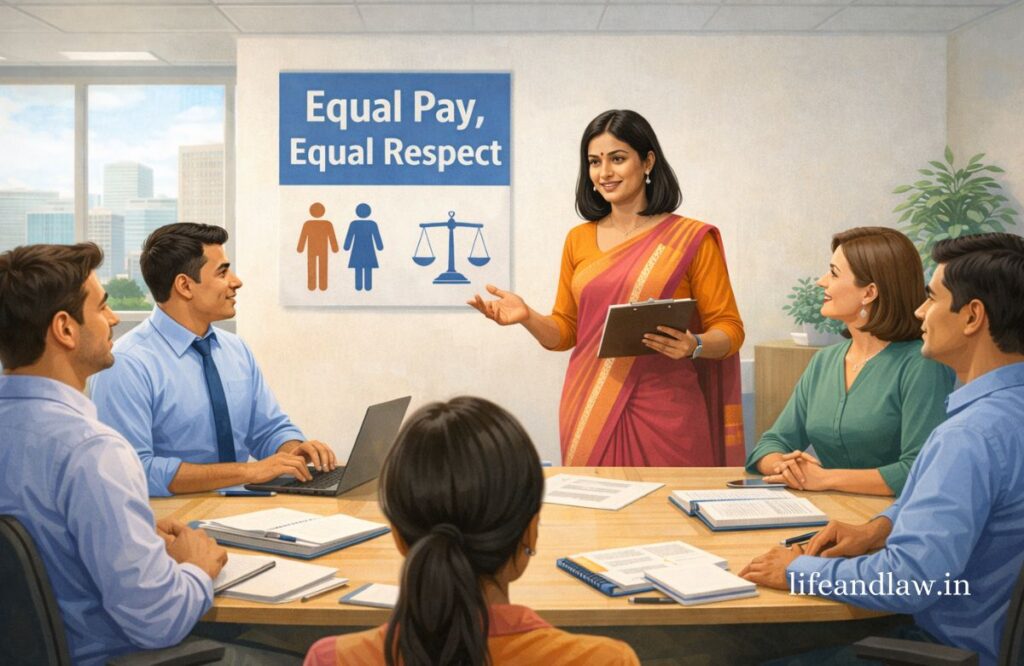
Despite the existence of legislation to safeguard women in the workplace, women in India frequently face significant impediments to equitable employment opportunities. Gender disparities in income, workplace sexual harassment, and limited prospects for career growth remain serious concerns. Despite these obstacles, regulatory frameworks such as the Sexual Harassment of Women at Workplace Act provide avenues for addressing workplace harassment.

In recent years, there has been a push for more women to enter the workforce, and employers must provide a safe and harassment-free atmosphere. Another example is the Maternity Benefit (Amendment) Act of 2017, which grants women the right to paid maternity leave for up to 26 weeks, thereby fostering gender equality at work.
Understanding the Laws Protecting Women’s Rights in India

1.The Constitution of India

The Constitution of India, which enshrines the ideal of equality for all citizens, serves as the foundation for women’s rights. Articles 14, 15, and 21 are very crucial to women’s rights. Article 14 provides equality before the law, Article 15 outlaws gender discrimination, and Article 21 safeguards the right to life and personal liberty, which courts have construed to include the right to live in dignity.

2.The Domestic Violence Act (2005)

The Protection of Women from Domestic Violence Act of 2005 was a watershed moment in domestic violence legislation, defining it as emotional, verbal, sexual, and economic abuse in addition to physical attack. This law allows women who have experienced domestic violence to seek protection orders, residency orders, and compensation against their abusers.

3.The Dowry Prohibition Act (1961)

The Dowry Prohibition Act of 1961 criminalises the giving and receiving of dowry and seeks to end a tradition that has resulted in violence against women, particularly in marriages. Dowry-related violence is a severe problem, but this law serves as an effective deterrent.

4.The Criminal Law (Amendment) Act (2013)

Following the 2012 Delhi gang-rape event, the Criminal Law (Amendment) Act, 2013, broadened the definition of sexual offences and imposed harsher penalties for crimes such as rape, sexual harassment, and stalking. It also addressed acid attacks, providing for victim compensation and rehabilitation.

5.The Hindu Succession (Amendment) Act (2005)

This change to the Hindu Succession Act of 1956 provided daughters equal property rights. Until this law, daughters had limited inheritance rights in ancestral property. The 2005 amendment granted daughters the same rights as sons, including the ability to inherit property and participate in its management.

Conclusion

India has made considerable strides toward securing women’s rights through legislation and judicial activism. However, obstacles persist, particularly in public views and law enforcement. Myths and misconceptions frequently muddle accomplishments, emphasising the significance of women being educated about their legal rights and the avenues for justice.

True empowerment will occur when legislative protections are successfully applied, resulting in societal change. India may progress toward gender equality by challenging stereotypes, strengthening legal enforcement, and shifting societal norms. Legal practitioners, including Adv. Abdul Mulla , contributes to this cause through services such as www.lifeandlaw.in and www.asmlegalservices.in, which offer advice on women’s rights and legal assistance.

RECENT POSTS

CATEGORIES

Leave a Reply

Your email address will not be published. Required fields are marked *

Life And Law Blogs

Life & law provides valuable insights by simplifying complex legal concepts and connecting them to real-life experiences …read more

Why I write

At Life & law, my mission is simple. to make the law accessible and empower people with knowledge to confidently face life’s challenges …read more

Copyright BlazeThemes. 2025